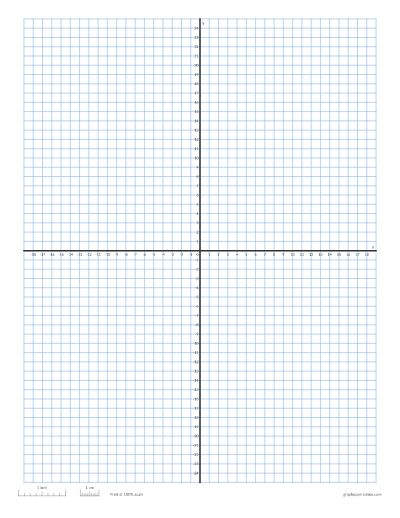
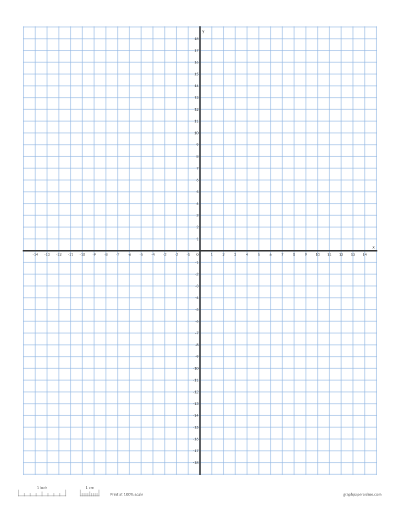
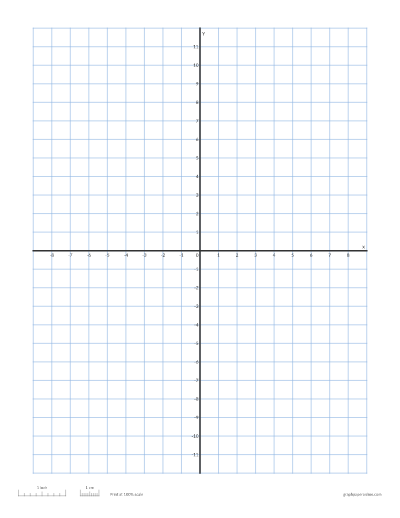
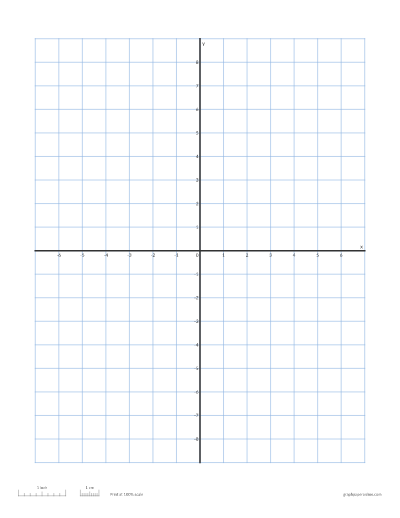
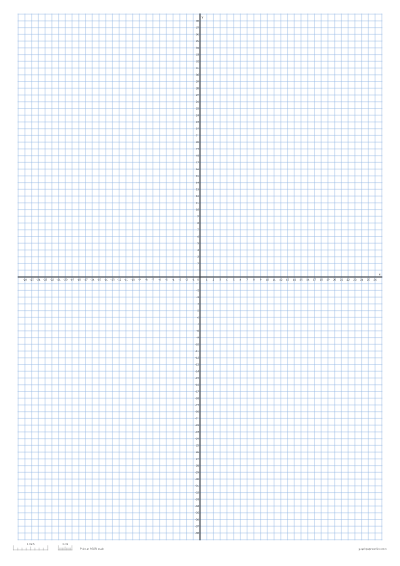
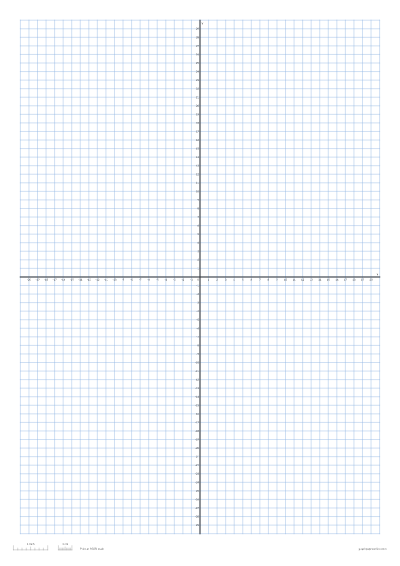
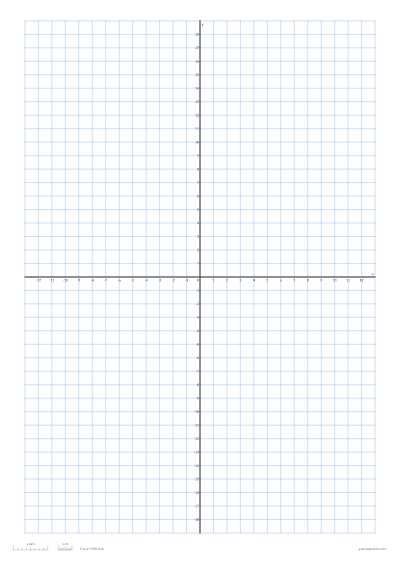
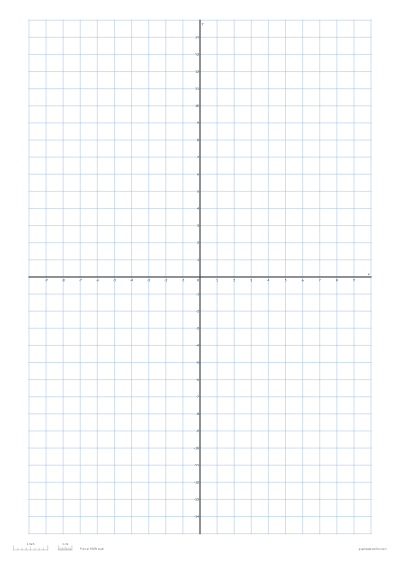
What is coordinate plane graph paper?
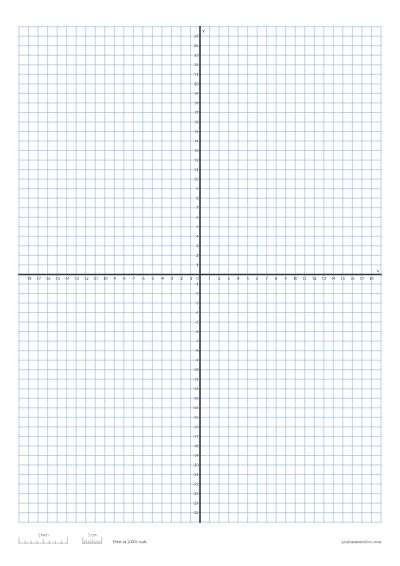
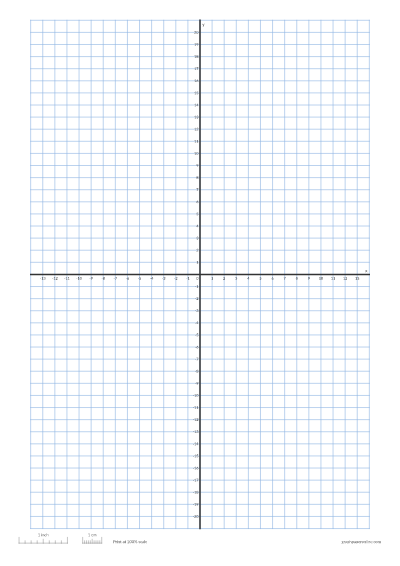
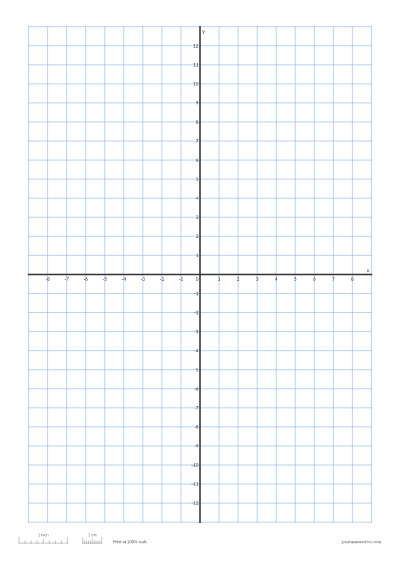
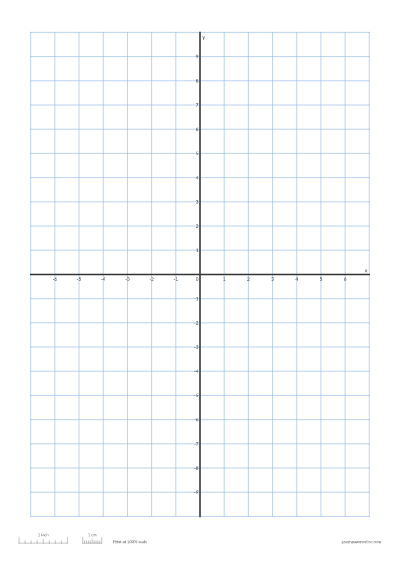
Coordinate plane graph paper is graph paper with an x-axis and a y-axis already drawn through the centre of the sheet. The axes cross at the origin (0, 0) and split the page into four quadrants. Each grid line along the axes is numbered, so students can plot points and read values without drawing and labelling axes first.
How to use it in class
- Plotting points: find (3, −2) by moving 3 right along the x-axis and 2 down.
- Graphing equations: draw lines, parabolas and other functions, then read off intercepts.
- Transformations: reflect, rotate and translate shapes across the axes.
- Distance and midpoint: count squares between points, then check with the formula.
- Data: make scatter plots when values can be negative.
Turn on Name and date line before printing a class set, and set the number of copies under More options → Pages in PDF.
How far do the axes go?
The grid is always centred, with the same number of squares on each side of the origin, so the axes fall exactly on a grid line. The table shows how far the grid reaches; the outermost line is left unnumbered so labels never sit on the border.
| Grid size | Range on Letter (portrait) | Range on A4 (portrait) |
|---|---|---|
| 5 mm | x −19 to 19, y −25 to 25 | x −19 to 19, y −26 to 26 |
| ¼ inch | x −15 to 15, y −19 to 19 | x −14 to 14, y −21 to 21 |
| 1 cm | x −9 to 9, y −12 to 12 | x −9 to 9, y −13 to 13 |
| ½ inch | x −7 to 7, y −9 to 9 | x −7 to 7, y −10 to 10 |
On small grids, numbers appear on every second square so they stay readable. Switch to Landscape for a wider x range, or turn off Axis numbers to label the scale yourself, for example counting in 5s or 10s.
Darker lines for scale
Under Darker line every, choose 5 or 10 to make every fifth or tenth line heavier, measured from the axes. It helps students keep track of larger numbers and makes reading values quicker. If your data grows by multiples rather than steps, plot it on semi-log graph paper instead.
Printing at the right size
The axes and numbers stay centred whatever paper you pick, including A3 and Tabloid for wall displays. For accurate squares, print at 100% / Actual size; see how to print graph paper at actual size. If you need a plain grid without axes, use the graph paper generator or 1 cm graph paper. For angles and circles, try polar graph paper.
Frequently asked questions
Can I print a single quadrant?
Not yet. The sheet shows all four quadrants. For first-quadrant work, use the top-right part of the grid, or a plain graph paper sheet with your own axes along the edges.
Why are some numbers missing on the 5 mm grid?
On grids smaller than about 5 mm, labelling every line would make the numbers overlap, so every second line is labelled instead.