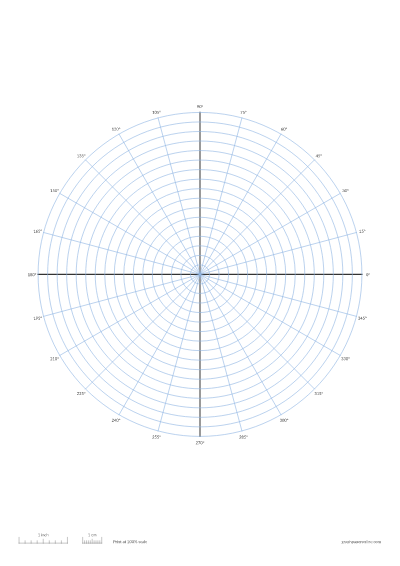
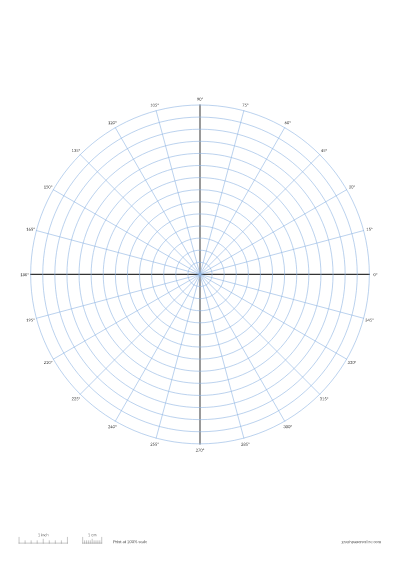
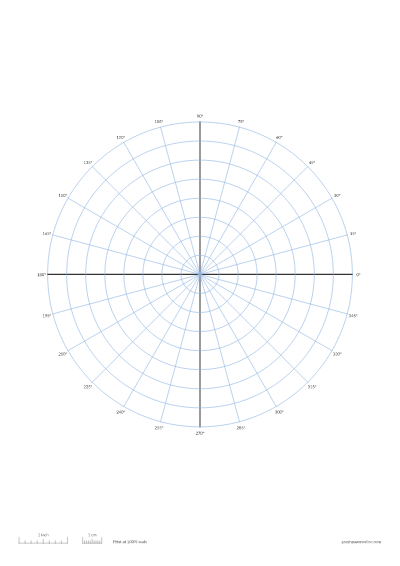
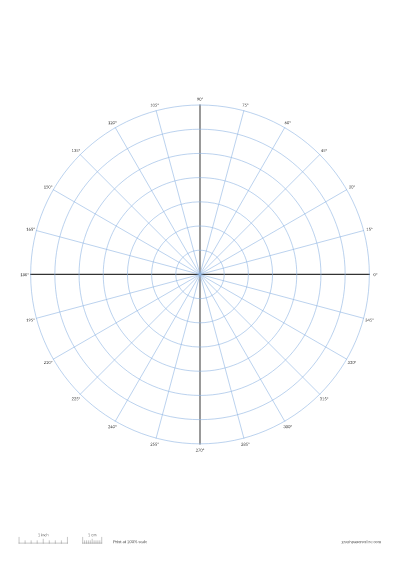
What is polar graph paper?
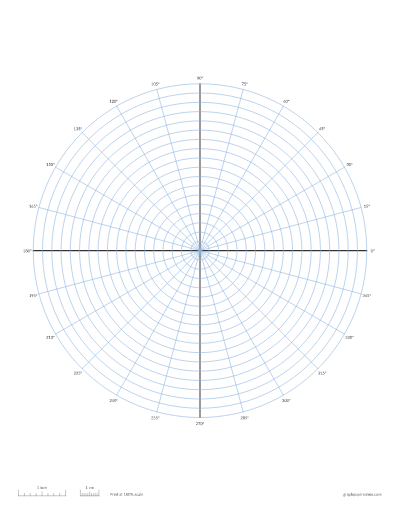
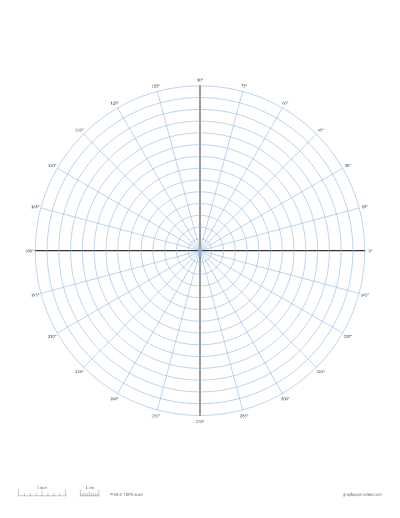
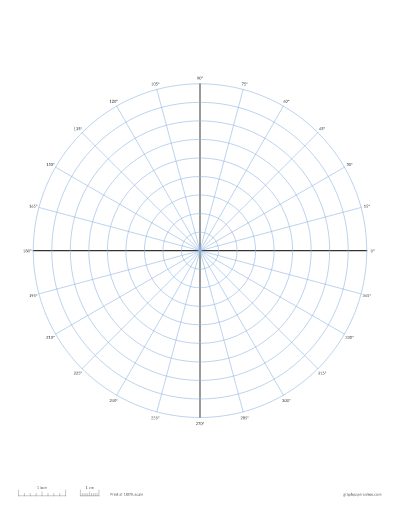
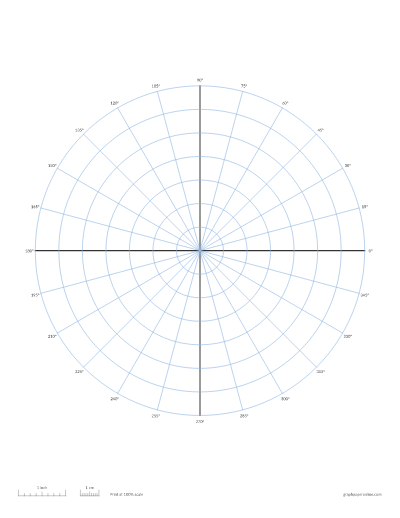
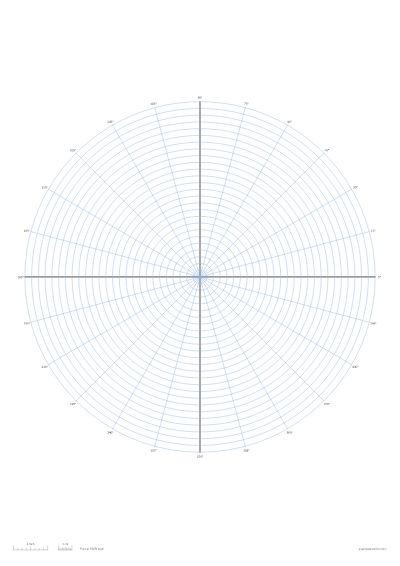
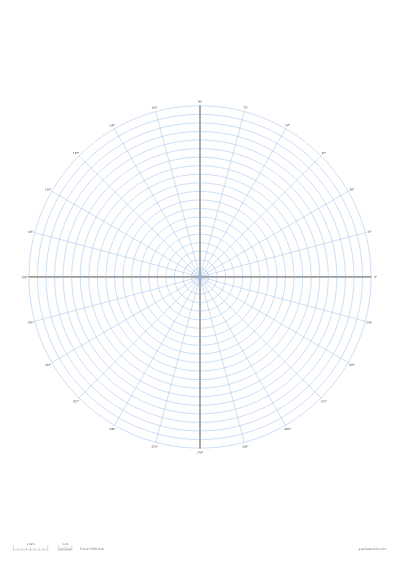
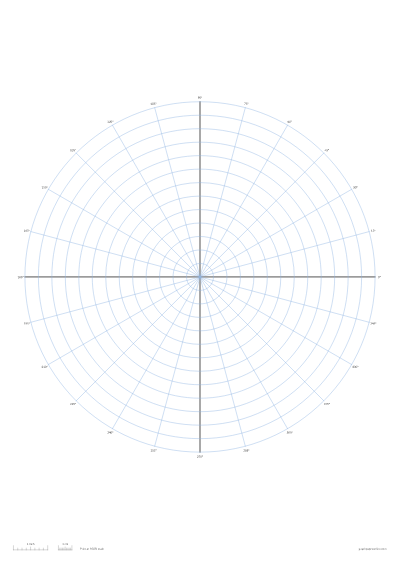
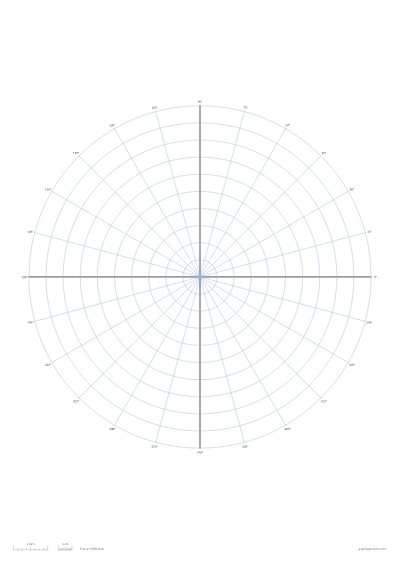
Polar graph paper locates points by distance and angle instead of x and y. It has a centre point (the pole), concentric circles at equal distances from it, and straight rays at equal angles. A point such as (r = 4, θ = 60°) sits on the fourth circle along the 60° ray.
On this sheet, 0° points to the right and angles increase anticlockwise, the usual convention in maths. The 0°, 90°, 180° and 270° rays are drawn darker so the axes are easy to find.
What it is used for
- Graphing polar equations: roses, cardioids, limaçons and spirals such as r = 2 sin 3θ.
- Trigonometry: show angles, radians and the unit circle.
- Physics and engineering: vectors, antenna radiation patterns and rotating systems.
- Navigation and astronomy: bearings and sky charts.
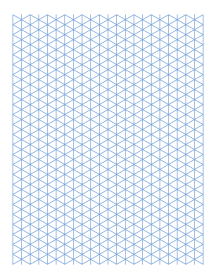
- Art and design: mandalas, clock faces and radial patterns. For geometric patterns built from triangles, try isometric graph paper.
Choosing ring spacing and angles
Ring spacing sets the distance between circles. On a Letter sheet, 1 cm rings give 9 circles across a 180 mm wide plot, and 5 mm rings give 18 finer circles. Use More options to enter any spacing from 2 mm to 50 mm.
Rays sets the angle between lines:
| Setting | Rays | Good for |
|---|---|---|
| 30° | 12 | Quick sketches, clock faces |
| 15° | 24 | Most homework, common angles |
| 10° | 36 | Detailed polar graphs |
| 5° | 72 | Precise plotting and navigation |
Turn Angle labels off for a clean grid, or keep them for degree values around the outside.
Printing a true circle
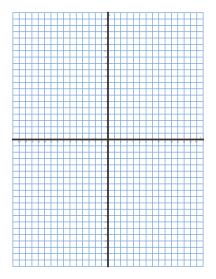
A circle only stays a circle if the printer does not stretch the page. Print at 100% / Actual size, not “Fit to page”, and check the ruler at the bottom of the sheet. The printing guide shows the setting in each browser. For Cartesian graphs, use coordinate plane graph paper instead.
Frequently asked questions
How do I plot a negative radius?
Go to the angle, then move the same distance in the opposite direction, which is the same as adding 180° to the angle.
Can I print polar graph paper in radians?
The labels are in degrees. Common radian values line up with the 15° setting: π/6 is 30°, π/4 is 45° and π/2 is 90°.